Phase 1 · Analysis and planning

Purpose, shaped for two seasons of life.

A source-led plan for two distinct biblical workbooks: one helping young people discern their future without premature pressure, and one helping adults integrate purpose with work, transition and service.

Primary source: 212-page book 10 chapters mapped Two audience-specific learning journeys Manuscripts held until approval

Executive recommendation

The workbooks should share one theological spine, but never feel like the same book with different examples.

  1. Young people: six-week hybridThree short sessions and one optional mentor or group checkpoint each week.
  2. Adults: eight-week flexible hybridOne substantial weekly session, two workplace practices and a short review.
  3. One visible source trailEvery module names the source chapter, theme and anchor scriptures.

Book and audience analysis

A pastoral theology of work, not a purpose-finding formula.

The book’s argument begins with identity in God, moves through calling and stewardship, and ends in faithful action. Its centre of gravity is not self-actualisation but a life offered to God through relationship, work, service, character and time.

01

Identity before activity

Readers are created in God’s image, become children of God through Christ, and must not derive their worth from role, status or achievement.

02

Calling before career

The primary call is to God and service. Occupations are seasonal platforms through which that calling can be expressed.

03

Stewardship before spotlight

Gifts are tools, not purpose. They require character, practice, faith, perseverance and a willingness to serve beyond oneself.

04

Faithfulness before status

Success is measured through obedience, growth, contribution and eternal significance rather than arrival, acclaim or material gain.


Central message

Purpose and profession belong together when work is understood as one instrument of God’s wider purpose. Any legitimate role can become worship through excellence, integrity, service and faithful use of what God has entrusted.

Chapter architecture

Chapters 1–3 establish identity, calling and work; 4–6 distinguish and develop gifts; 7–10 reframe success and apply purpose through worship, good works and time stewardship.

Teaching style

Direct second-person address, accessible exposition, frequent scripture, personal candour, memorable contrasts, extensive biblical and public-life examples, and practical action points at chapter endings.

Distinctive voice

Warm, earnest and occasionally playful. The author speaks as a fellow traveller in church and corporate life, repeatedly rejecting a sacred–secular divide and quick motivational formulas.

Stories and examples

Nehemiah, Moses, Joseph, Peter, David, Esther, Bezalel and Oholiab, Saul, Samson, Solomon and Joshua sit alongside the author’s work experiences and examples from leadership, justice, science, sport and the arts.

Adaptation opportunity

The source provides rich teaching but its activities are mostly end-of-chapter. The workbooks can faithfully convert repetition and exposition into short lessons, guided discernment, experiments, reviews and accountable next steps.


Audience implication

The same truth must answer different questions.

  • Ages 13–21 ask, “Who am I becoming?”They need identity security, exploration, counsel, practice and permission for purpose to unfold across seasons.
  • Working adults ask, “How do I live this now?”They need integration, ethical judgement, resilience, transition discernment, rest and a credible practice within real constraints.

Source atlas

Every proposed module has a visible route back to the book.

Select a chapter to see its teaching burden, anchor scriptures, major examples and intended workbook use. Page references follow the book’s printed pagination.

Ephesians 2:10Genesis 1:26–28; 2:15Colossians 3:23–241 Peter 4:10Matthew 5:16Micah 6:8Ephesians 5:15–16

Workbook 01 · Young people

Discovery without the pressure to have life solved.

Position this as a guided faith-and-future journey for secondary pupils, students and early starters. Its promise is clarity for the next faithful step, not a permanent career prediction.

Recommended title

Purpose Starts Here

A 6-Week Journey to Discover Who God Made You to Be, Grow Your Gifts and Shape Your Future

Series line: A Purpose & Profession workbook inspired by Oluwatobi Adekunle’s book.
Alternative titles
  • Made With Purpose — Identity, Gifts and Faithful Next Steps
  • More Than a Future Job — Finding Purpose in School, Service and What Comes Next
Secure identity

Separate God-given identity from grades, popularity, appearance, family expectations and future job titles.

Discern with evidence

Notice gifts, passions, needs, feedback, opportunities and spiritual guidance without equating talent with purpose.

Practise faithfulness

Use study, chores, relationships, early work and service as current places for worship, growth and contribution.

Choose wisely

Bring prayer, scripture, counsel and seasonal awareness into subject, course, training and early career decisions.

Grow character

Pair ability with discipline, integrity, perseverance, teachability, rest and continual learning.

Take one real step

Finish with a provisional Purpose Compass and a 90-day experiment, supported by a trusted adult or mentor.

6 weeks

Recommended cadence

Three sessions of 15–20 minutes each week, plus an optional 30–45 minute mentor, family or small-group review. Eighteen core sessions in total.

Why this is strongest

A rigid daily streak is vulnerable to school pressure and guilt. Pure self-pacing makes postponement easy. A light weekly rhythm gives momentum, variety and social support without infantilising older readers.

Sample page concepts

Write, sort, test, talk and serve.

The activity mix should feel active and mature, with visual space to think. Each session follows a compact rhythm: Start Here → Scripture Lens → Make It Personal → Try It → Pray It.

  • Identity LayersSort “roles that change” from “truths rooted in God”, then write a one-sentence identity anchor. Source: Ch. 1.
  • Job or Work?Place schoolwork, chores, a part-time shift, music practice, caregiving and volunteering on a job/work/purpose map. Source: Chs. 2–3.
  • Gift Evidence BoardCompare energy, observable fruit, repeated feedback and service opportunities; ask a mentor for evidence rather than praise. Source: Ch. 4.
  • Tool, Not DestinationBuild a chain from ability → people served → need addressed → God-honouring outcome. Source: Ch. 5.
  • 14-Day Growth SprintPair one skill practice with one character habit, track setbacks and review what changed. Source: Ch. 6.
  • Success Scoreboard ResetReplace likes, rank and comparison with faithfulness, growth, contribution and wise next steps. Source: Ch. 7.
  • Study as WorshipChoose one ordinary responsibility and practise excellence, honesty, service, gratitude and rest for a week. Source: Ch. 8.
  • Good Work NearbyPlan one small act of mercy or justice in family, school, church or community, then reflect on motive and impact. Source: Ch. 9.
  • Attention ExchangeAudit a normal week and exchange one distraction block for prayer, practice, relationship or service. Source: Ch. 10.

Workbook 02 · Working adults

From career tension to an integrated practice of purpose.

Position this for employed, self-employed and transitioning adults who need a framework robust enough for deadlines, leadership, ethical pressure, redundancy, caregiving, business decisions and changing seasons.

Recommended title

Purpose at Work

An 8-Week Workbook for Aligning Faith, Calling and Professional Life

Series line: A Purpose & Profession workbook inspired by Oluwatobi Adekunle’s book.
Alternative titles
  • Work With Purpose — Faithful Practice for Career, Business and Transition
  • The Purpose–Profession Practice — An Integrated Guide to Work, Calling and Service
Detach worth from role

Build an identity resilient enough for promotion, underemployment, career change, business volatility, retirement and redundancy.

Map calling across seasons

Distinguish enduring calling from present occupation and understand how paid work, family, church and community can interact.

Steward capability

Evaluate gifts, character, learning, perseverance and the organisational context in which contribution becomes possible.

Practise workplace worship

Translate faith into excellence, integrity, service, leadership, wise witness, prayer, gratitude and sustainable rest.

Navigate change wisely

Discern whether to stay, reshape a role, prepare, transition or wait without treating frustration as automatic divine direction.

Build a 90-day rule of work

Commit to a practical pattern of purpose across role, relationships, service, time, growth, boundaries and accountability.

8 weeks

Recommended cadence

One 45–60 minute weekly deep-dive, two 10-minute practices during the working week, and a 15-minute review. Allow an 8–12 week completion window.

Why this is strongest

Daily pages can become another performance demand. A flexible workweek rhythm protects depth while letting readers apply ideas in live professional situations before reviewing the evidence.

Sample page concepts

Discern, diagnose, practise and review.

Each module follows a mature work cycle: Frame → Scripture Study → Diagnose → Workplace Practice → Debrief → Pray. Cases should include employees, founders, freelancers, managers, carers and people between roles.

  • Role–Identity Separation AuditIdentify where title, income, reputation or productivity has become a source of worth. Source: Ch. 1.
  • Calling–Occupation PortfolioMap enduring service themes across paid work, family, community and church through different seasons. Source: Chs. 2–3.
  • Contribution ChainConnect gift and skill to stakeholder, need, organisational mission and God-honouring outcome. Source: Chs. 4–5.
  • Stewardship 360Rate talent, character, disciplined practice, faith, perseverance, teachability and feedback; select one constraint to address. Source: Ch. 6.
  • Success ReframeReview a promotion, failure, plateau or transition through faithfulness, growth, contribution and legacy. Source: Ch. 7.
  • Work-as-Worship DiagnosticAssess excellence, ethics, service, mastery, attitude, rest, humility, prayer and witness. Source: Ch. 8.
  • Ethical Pressure LabWork through realistic cases involving dishonest reporting, customer treatment, staff care, conflicts of interest and the wise expression of faith. Source: Ch. 8.
  • Influence and Good Works MapIdentify immediate opportunities for ordinary service, mercy, justice, advocacy, generosity and empowerment. Source: Ch. 9.
  • Calendar Redemption ReviewCompare stated priorities with actual time, then protect deep work, relationships, service, spiritual life and rest. Source: Ch. 10.

Shared foundation · different experience

Connected by doctrine. Separated by life stage.

Core question

Who am I becoming, and what can I do next?Exploration, identity and faithful experiments.
How do I live purpose faithfully in this season?Integration, discernment and sustained practice.

Contexts

School, college, university, home, church, first workPeers, grades, subject choice, social media, family expectations and new independence.
Employment, business, transition, leadership, home and communityDeadlines, income, ethics, responsibility, care, burnout, redundancy and legacy.

Depth

Short, concrete and guidedOne main idea per session; visible examples; optional mentor dialogue.
Layered, diagnostic and appliedLonger scripture study; competing values; workplace cases; seasonal complexity.

Purpose statement

A provisional Purpose CompassExplicitly open to growth, counsel and changing seasons.
A current-season purpose practiceLinks identity, calling, platform, contribution, boundaries and accountability.

Progress checks

Weekly “Notice, Name, Next” reviewsBrief and encouraging, with an optional trusted-adult signature or conversation.
Modules 2, 4 and 6 integration reviewsEvidence-based reflection on habits, tensions and workplace practice.

Shared non-negotiables

Identity in Christ; scripture; prayer; gifts as tools; service; characterNo deterministic career test and no promise of instant clarity.
Identity in Christ; scripture; prayer; gifts as tools; service; characterNo sacred–secular split and no reduction of purpose to job satisfaction.

Visual direction and design system

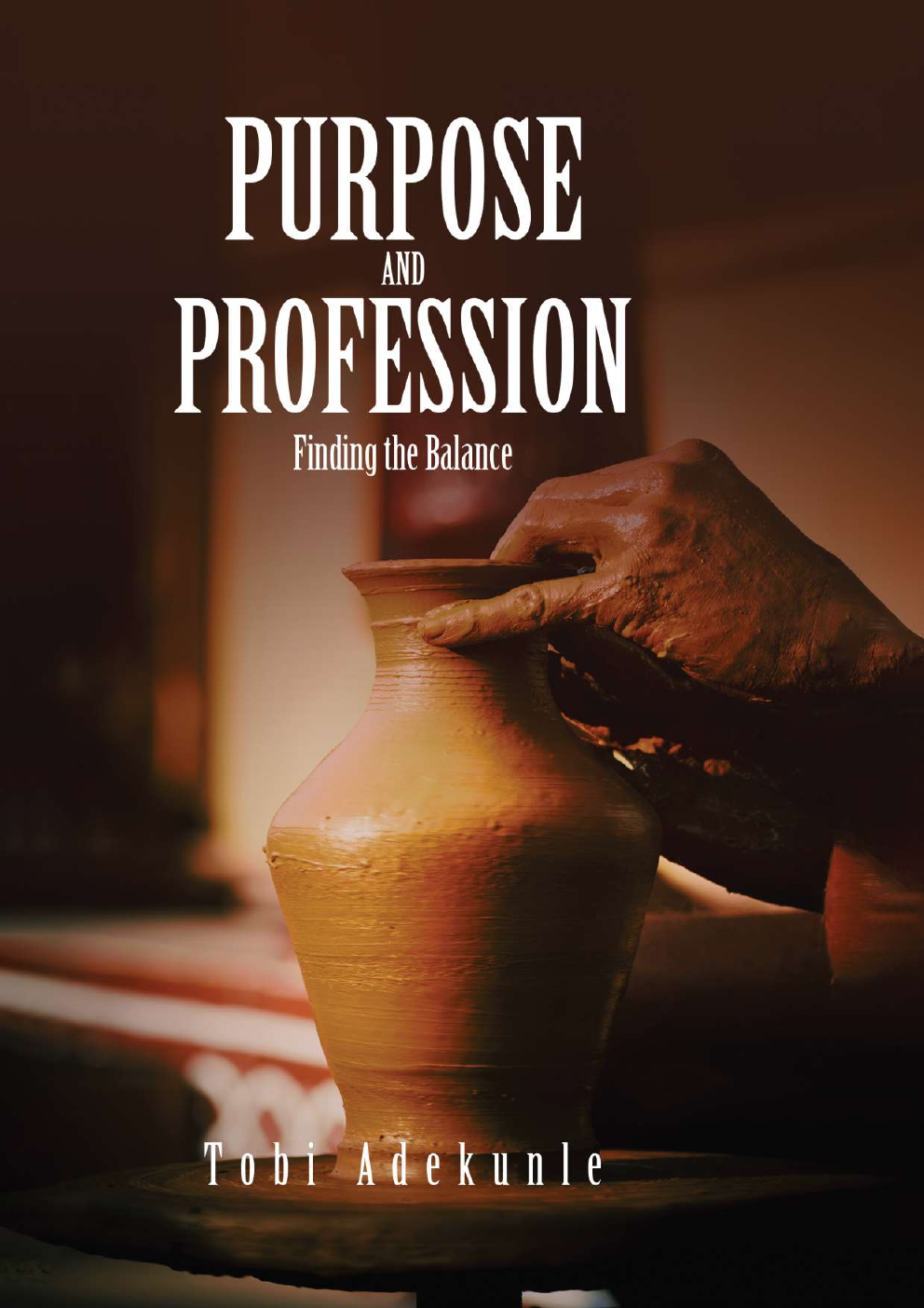
Cover of Purpose and Profession: Finding the Balance by Tobi Adekunle, showing hands shaping a clay vessel in warm amber light
The cover’s clay vessel supplies the visual metaphor: purpose is formed, stewarded and expressed over time.

Warm, tactile and editorial.

The system should inherit the cover’s dark warmth, concentrated light and craft motif while improving contrast, navigation and writing space. Premium means restraint: strong type, generous margins, quiet rules and purposeful imagery rather than decorative religious symbols.

Deep ground#160D09
Fired clay#8C3F24
Terracotta#C86F42
Amber light#D99A4A
Parchment#F6EFE3
Purpose takes shape.

Display: a high-contrast editorial serif that echoes the cover without copying its compressed type. Reading and activity text: a clean humanist sans serif with clear numerals, generous line height and strong small-size legibility.

Shared series

Both books use the same cover family, chapter openers, source notes and clay/amber palette so their origin is unmistakable.

Youth edition

More open space, bolder module numerals, friendly diagrams and “choose your context” labels for school, study and starting work. Energetic, never childish.

Adult edition

Denser editorial rhythm, sophisticated diagnostics, workplace cases, note margins and restrained charts. Calm enough for serious reflection.

Page grammar

Warm-up, concise teaching, scripture study, reflection, activity, prayer, action and source trail appear in a consistent sequence without forcing every page into a box.

Motifs

Concentric vessel rings, cropped hand-and-clay photography, fine contour lines and light moving across dark surfaces. No generic arrows, targets or mountain-top clichés.

Accessibility

High contrast, minimum 11-point print text, colour never carrying meaning alone, generous writing areas, plain-language directions and reduced-motion support in digital versions.

Assumptions, risks and editorial safeguards

Protect the author’s theology without carrying avoidable ambiguity into the workbooks.

The report recommends faithful adaptation, not silent correction or expansion. These points should be resolved before full drafting.

ConfirmDerivative-work and visual permissions
The PDF reserves reproduction rights. Confirm written authority to adapt the book into two workbooks, paraphrase its teaching, reuse or derive visual direction from the cover, and include any author biography or branding. This is a production prerequisite, not a challenge to the present analysis.
RecommendedScripture-text policy
Use references and short excerpts in the manuscript, retaining the source translation where it is explicitly identified. Before publication, verify every quotation against the chosen Bible edition and obtain any required permissions. The source mixes labelled and unlabelled translations and contains a few incomplete references.
SafeguardTheological precision around good works
Chapter 9 strongly distinguishes Christian good works from charity outside Christ and grounds righteousness in grace rather than deeds. Retain that perspective, but ask the author or a nominated theological reviewer to approve the precise workbook wording so the exercises neither dilute the claim nor make unsupported additions.
Safeguard“God as ultimate employer” metaphor
This is one of the book’s most distinctive adult-workplace images. Present it as the author’s practical lens for accountability to God, while retaining the book’s own insistence that readers honour paid responsibilities and do not use employer time for unrelated religious activity.
RecommendedSource verification and quotation restraint
The book draws on many theologians, leaders and public figures. The workbooks should paraphrase most supporting authors, verify historical claims that survive adaptation, and avoid reproducing substantial third-party quotations. Exact contemporary statistics should be omitted or re-sourced at drafting time.
ConfirmThe wide 13–21 age range
A thirteen-year-old and a twenty-one-year-old face materially different decisions. The recommendation is one core workbook with optional context lanes — School, Further/Higher Education and Starting Work — plus age-neutral language. Confirm whether this is preferable to separate editions.
SafeguardYouth facilitation and privacy
Mentor and group use should never require disclosure of private family, spiritual or emotional material. Sharing prompts should be optional, major decisions should encourage trusted counsel, and the workbook should avoid claiming that a self-assessment can reveal God’s complete plan.
RecommendedPastoral handling of career change
The adult workbook should not imply that dissatisfaction proves misalignment with purpose. It should test several faithful options — remain, reshape, prepare, transition or wait — using prayer, scripture, counsel, responsibilities, character and circumstances, all grounded in Chapters 2, 3, 7, 8 and 10.
ConfirmPhase 2 deliverable boundary
The recommendation is two complete, copy-edited manuscript packages with page-level activity instructions and a source trace, ready for design. Final illustration, print typesetting, ISBN, permissions clearance and external theological endorsement should remain separate production steps unless explicitly added.

Approval gate

Decide what moves into Phase 2.

The controls save only in this browser. Generate a concise review summary to copy into your response or editorial notes.

Already recommended: two distinct learning journeys; a six-week youth hybrid; an eight-week adult hybrid; source trails; a restrained cover-derived visual system; and manuscript drafting only after approval.
Decision 01Young people’s title
Decision 02Working adults’ title
Decision 03Programme formats
Decision 04Youth use model
Decision 05Age-range treatment
Decision 06Scripture and theological review
Decision 07Permissions status
Decision 08Phase 2 scope

Review summary

Exact proposed Phase 2 scope

  • Young people: complete introduction, reader/leader guidance, 18 short sessions across six modules, six reviews, context-lane prompts, self-assessments, scripture studies, prayers, a Purpose Compass and a 90-day experiment.
  • Working adults: complete introduction, eight modules, workplace cases, diagnostics, scripture studies, prayer and practice prompts, three integration reviews and a 90-day Rule of Work and purpose action plan.
  • Shared: consistent source trails to book chapters and scriptures, manuscript-level page concepts, cross-reference checks, editorial consistency and an adaptation/source matrix.

Not included unless added

  • Final typesetting, original illustration, commissioned photography or print-production files.
  • Bible, third-party quotation or cover-image permissions clearance.
  • ISBN, printing, distribution, marketing copy or a separate facilitator’s guide.
  • External theological, safeguarding, legal or educational endorsement.

Recommended next steps

Approve the frame before expanding the page count.

  1. Resolve the approval gateConfirm titles, formats, age treatment, use model, scripture policy, permissions and Phase 2 boundary.
  2. Build the source matrixLock every session to its primary chapter, scripture anchors, book stories and adaptation limits before prose drafting.
  3. Prototype one module eachDraft and review a representative youth module and adult module to calibrate voice, theological depth, activity load and page rhythm.
  4. Draft in complete journeysWrite each workbook end-to-end, including reviews and final plans, then check for genuine audience distinction and source fidelity.
  5. Review, verify and prepare for designRun author/theological review, scripture verification, editorial consistency, permissions checks and manuscript hand-off.
← All reports